
Sales Strategy
SalesGlobe can help your organization plan, design, and implement the transformational change to get you to the next level.
We operate in a continuously changing environment of customer expectations, competitive offers and macro market evolution. Most companies need to periodically transform their sales strategy to strengthen the business amid competitive environments or to enable the company to reach the next level. If your sales strategy and overall sales program hasn't changed in some time, you may find yourself in a reactive situation that requires change for survival.
Some of the underlying drivers of major sales change include:
- Change in the market or customer needs (52% of companies).
- Evolution in technology or product (22% of companies).
- Merger or acquisition (15% of companies).
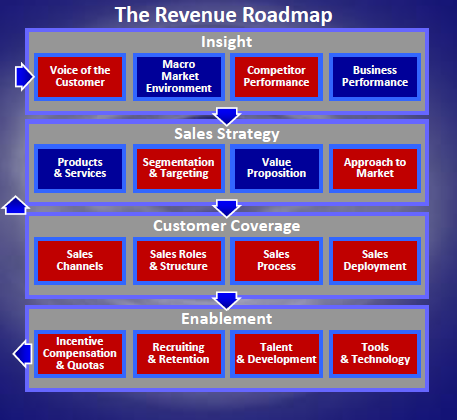
A successful sales strategy considers that alignments of several sales disciplines along The Revenue Roadmap which provides an integrated view of the four major competencies of successful sales organizations:
- Insight on customers, the market, and internal performance.
- Sales Strategy that determines direction for the organization in terms of customer and product focus.
- Customer Coverage that defines the organization's routes to market, sales organization and roles, and sales process.
- Enablement that supports the upstream disciplines through recruiting, development, technology and your sales compensation plan.
You can learn more about The Revenue Roadmap approach to building and aligning sales strategy in our book, The Innovative Sale.
Let's Get to Work
How Sales Strategy Drives Sales Compensation
Sales compensation doesn't exist in a vacuum. It is the downstream execution of your sales strategy. When a company defines which customers to target, which products to prioritize, and how it will go to market, those decisions must be translated into how salespeople are paid. A compensation plan that doesn't reflect the sales strategy sends conflicting signals to the sales force — and the compensation plan will always win.
The Revenue Roadmap makes this relationship explicit. It begins with Insight — understanding the market, competitors, and your own performance. That insight informs Sales Strategy, which then shapes Customer Coverage, and finally Enablement — including sales compensation — funds and motivates the journey. When these layers are misaligned, companies invest heavily in strategy that never reaches the customer.
The Four Core Disciplines of Sales Strategy
SalesGlobe's approach to sales strategy is built on four disciplines that every sales organization must get right:
Products and Services Focus — Define the core offerings your business will prioritize based on market opportunity and customer need. Not all products deserve equal sales attention, and strategy requires making deliberate choices.
Segmentation and Targeting — Decide which customers you are going after and why. Effective segmentation considers buyer type, company size, industry, and buying behavior. Targeting ensures your sales resources are allocated where they will generate the greatest return.
Value Proposition — Articulate what you accomplish for customers and how you differentiate from competitors. A strong value proposition is specific, customer-facing, and tied to measurable outcomes.
Approach to Market — Design how your sales organization will execute the strategy — through direct sellers, channel partners, inside sales, or a hybrid model. This is where strategy becomes structure.
Sales Strategy and Sales Compensation Alignment
One of the most common failures in sales transformation is designing a new sales strategy and leaving the compensation plan unchanged. When pay doesn't reflect the new direction, the sales force defaults to rewarding behavior from the old strategy. SalesGlobe's work with hundreds of companies — detailed in What Your CEO Needs to Know About Sales Compensation — consistently shows that compensation alignment is the critical final step in any strategy change.
The questions that connect strategy to compensation include: Are your sales roles defined to support the strategy? Does pay mix reflect the type of sale and the degree of seller influence? Do your incentive measures prioritize the right products and customer segments? Are your performance measures tied to the customer segments and products your strategy has identified? Are quotas set in a way that reflects the market opportunity your strategy has identified?
Industries We Serve
SalesGlobe has designed and implemented sales strategies across technology, SaaS, telecommunications, wireless services, professional services, information services, staffing and recruiting, healthcare, and cloud and managed services companies. Our cross-industry experience gives us a distinct advantage: we bring proven strategy frameworks to every engagement while customizing for your specific market dynamics, competitive landscape, and customer buying behavior.
Whether you are entering a new market, launching a new product line, or transforming an existing sales model, we help you build a strategy from the customer up. Our work spans product and services focus, segmentation and targeting, value proposition development, and approach to market design across every major B2B vertical.